

Quick answer: A kids' electric scooter in the UK is a private-land machine that does laps of a garden, a path or a driveway in British weather. That makes most of the specs on a listing irrelevant and two of them critical — the battery chemistry and the lowest speed setting. Range, which every listing leads with, barely matters at all.
Here's what each number actually tells you, so you can read any listing properly rather than taking the big print on trust.
Just want to know which of ours? Two sizes covering ages three to thirteen. See both →
What a kids' scooter in the UK actually has to do
Worth starting here, because it's the thing that decides which specs matter.
A privately owned e-scooter can't legally be ridden on a road, a pavement or a cycle lane in the UK. It's private land only, with the landowner's permission — which in practice means a garden, a path, a driveway or a relative's. Are Electric Scooters Legal for Kids in the UK? has the full position.
So the job is short, repeated laps on a hard surface, often damp, usually within shouting distance of the back door. Not a commute. Once you accept that, half the spec sheet stops mattering.
The numbers that matter, and what they mean

Battery chemistry. The single most important line, and the one most often left out. Lithium holds its capacity for years; sealed lead-acid is heavy, slow to charge and noticeably weaker within a year. If a listing doesn't say "lithium", work on the basis that it isn't. Ours are lithium.
For a first scooter, the lowest speed setting — not the highest. Every listing shouts the top speed. For a child who has never used a throttle, the number that decides whether the first week goes well is the slowest one. A scooter whose bottom setting is 5 km/h is slower than a jog, so you can walk alongside them. For a child who is already confident, this matters far less, and a single well-judged top speed is fine — which is why scooters aimed at older children often have one speed rather than three.
Motor wattage. Not a speed figure — a pulling figure. More watts means it keeps going up a slope and doesn't bog down under a heavier child. On a flat patio, 130W is plenty for a small rider. If there's any kind of incline, or the child is at the upper end of the weight range, it's the number that decides whether the scooter feels willing or tired.
Maximum rider weight. A stated number means someone tested the frame. No number usually means nobody did. It also tells you how long the scooter will last you — a child approaching the limit will feel the thing getting slower and softer before you notice anything.
The IP rating. Two digits, and only the second one matters here: it's the water digit. IP54 and IPX4 both mean splash resistant — fine for damp ground and light rain, not for puddles or a hose. An unrated scooter in a British October is a gamble.
Two numbers that mislead
Range. The headline spec on almost every listing, and close to meaningless for this use. A child doing laps of a garden is not going to run out at 7km. What ends a session is cold hands, tea, or losing interest — never the battery. Paying more for range you'll never reach is the most common mistake in the category.
Top speed. A big number on a kids' scooter is a warning rather than a feature. What you want is a sensible ceiling and a low floor, with steps in between. Anything advertising adult speeds on a children's frame is telling you something about the people who built it.
Solid tyres are a choice, not a cost cut
This one gets written up as a corner cut and it usually isn't.
Air-filled tyres are more comfortable and grip better on rough ground. They also puncture, need checking, and go soft in a shed over winter — which on a child's scooter means a flat tyre discovered five minutes before they wanted to ride.
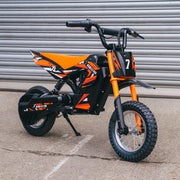
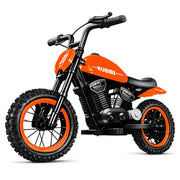
Solid tyres give up some comfort and get it back in never needing anything. For a scooter living on hard surfaces, that's the right trade, and it's why ours run 6.5-inch solid tyres. On a dirt bike, which is working on grass and mud, the opposite is true — there the air-filled tyre earns its keep.
What you're actually looking for is suspension on the bigger models, which does the comfort job the tyres gave up.
Brakes — the bit nobody mentions
Almost no listing says anything useful about braking, and it's the one system a nervous parent should ask about.
Two things to look for. First, how many brakes: a scooter with both a front and a rear brake stops shorter and more predictably than one with only a rear. Second, whether a small hand can actually work the lever — a lever sized for an adult grip is no use to a six-year-old in gloves, and no spec sheet will tell you that.
If you can, squeeze it before you commit. If you can't, ask the seller how far the lever travels and whether the reach is adjustable.
The things that aren't specs at all
Three questions that matter more than any number on the page, and none of them is answered in a spec table.
Can you buy a part? Scooters are ridden hard by people who don't look after them. Throttles, brake levers, chargers and wheels all wear out. Look for an actual parts list with prices, not "contact us for spares" — ours are listed per model, including the S4 Pro.
How long is the warranty, and who honours it? Twelve months from a UK business is a different proposition from twelve months from a marketplace seller who may not exist in the spring.
Who answers the phone? Find out before you need to.
Where ours land
Two models, covering ages three to thirteen.
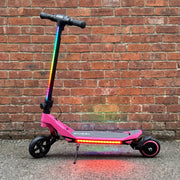
The S4 Pro is the first-scooter one: a 130W motor, three speed settings starting at 5 km/h, a handlebar that adjusts through 20cm, front and rear brakes, and a 60kg rider limit. Ages 3–9.
The S7 Pro is the step up, and it works differently: a single sensible top speed of 16 km/h rather than selectable settings, a 200W motor, rear spring suspension that makes a real difference on gravel and uneven paving, an LED display, and a 70kg limit. That is deliberate — it is built for a child who is already riding confidently, which is why it starts at seven rather than three. If you want to start a beginner slowly, the S4 Pro is the one. Ages 7–13.
Both are lithium, both fold, both run solid 6.5-inch tyres and both carry a 12-month warranty. For the full side-by-side, the scooter buying guide has the complete comparison. For whether your child is ready and which height fits, What Age Can a Child Ride an Electric Scooter? walks through the checks.
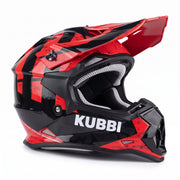
On safety kit, a scooter doesn't need a full-face motocross helmet — a cycle-style helmet and a set of pads is the right kit, and wrists and knees take the impact rather than the chin. Our accessories range covers it, and sizes do sell out, so sort it with the scooter rather than after.
Frequently asked questions
What's a reasonable amount to spend?
Enough to get a lithium battery, a stated rider weight, an IP rating and a real warranty. Below that you're buying something that looks like a scooter and behaves like a toy. Current prices are on each product page.
Is more power always better?
No. For a small child on a flat surface, a smaller motor with a gentle starting speed is the better machine. Power matters when there's a slope or a bigger rider.
How long will one last before they outgrow it?
It depends on the handlebar range and the weight limit rather than the age on the box. A scooter whose bars adjust through 20cm covers several years; one with a fixed bar covers one.
Can they ride it in winter?
Yes, within reason. Splash resistant means damp paths and light rain are fine, puddles and jet washes are not. Cold weather shortens the ride before the battery does — gloves make more difference than anything.
Does my child need a licence or insurance?
Not on private land. Both only become questions on public roads, where a privately owned e-scooter can't legally go anyway.
Solid or air-filled tyres — which should I pick?
For a scooter on hard surfaces, solid. The comfort you lose is smaller than the maintenance you avoid, and it's one fewer thing to go wrong on a cold morning.
The bottom line
Check the battery says lithium. If it's a first scooter, check the lowest speed setting rather than the highest. Check there's a stated rider weight and an IP rating. Then ignore the range figure, because you will never get near it.
Everything after that is whether the company behind it will still be answering the phone when the throttle wears out.
Browse the Kubbi scooter range →
Kubbi supplies electric bikes and scooters to over 15,000 UK families. Everything ships from our own UK warehouse with a 12-month warranty and spare parts held in stock.