

Quick answer: The licence and insurance rules GOV.UK sets out apply to public roads and public places, not to genuinely private land. That is why almost nobody riding an electric dirt bike on their own ground needs either. The part most people miss sits in the middle: public place is its own category, it is wider than road, and "not required" is not the same as "covered".

This is general guidance rather than legal advice, and it is written for the UK. If you are in any doubt about your own situation, your insurer and the landowner are the two people to ask.
The whole answer, by where you ride
| Where | Licence | Insurance | Tax, MOT, plate |
|---|---|---|---|
| Private land, with permission | Not required | Not required — and not covered | Not required |
| A public place, even off the road | Ask before you ride | Required | Ask before you ride |
| Public road | Required | Required | Required |
GOV.UK states the insurance requirement for a road or a public place. It does not set out the private-land position directly, so the top row is our reading of what follows from that, not a quotation.
The bottom two rows are mostly theoretical, because an off-road electric dirt bike is not built to meet the standards road use requires. That is worth understanding properly, and it is the next section.
Why you cannot simply register one and ride it
People assume this is a paperwork problem: fill in the right forms, pay the right fees, get a plate. It is not.
A machine goes on the road once it has vehicle approval. For a solo motorcycle with no existing type approval, one route is Motorcycle Single Vehicle Approval, run by the Driver and Vehicle Standards Agency. GOV.UK sets out what qualifies: the vehicle must be under 10 years old, must not have been registered in the UK before, and must not already hold type approval. Pass the inspection and DVSA issues a Minister's Approval Certificate.
Nothing in that is impossible in principle. In practice almost nobody does it for an off-road electric bike, because the machine then has to satisfy standards it was never designed around. In our experience the result is a heavier bike that is more compromised on the ground it was built for.
Then there is the licence. GOV.UK is clear that to ride on public roads you need a provisional licence and compulsory basic training first. The categories above that are banded by power or speed: AM covers mopeds from 25 to 45 km/h, from 16; A1 covers light motorcycles up to 11 kW and 125 cc, from 17; A2 up to 35 kW, from 19; and the unrestricted category A from 24, or from 21 by progressive access.
So the honest summary is that road use is a different product, not a different form. A road-registered machine is a different bike from the one you are reading about.
"Private land" is narrower than most people think
This is the part that catches people out, and it is the reason this article exists.
The insurance requirement does not stop at the kerb. GOV.UK puts it this way: it is illegal to drive a vehicle "on a road or in a public place" without at least third-party insurance, and the police can issue a fixed penalty of £300 and six points.
The phrase doing the work there is public place. GOV.UK lists it alongside road rather than inside it, and does not define it — so a place can be somebody's property and still not be the quiet legal backwater people assume.
Whether a particular field, yard, car park or stretch of waste ground falls inside that phrase is a question for your insurer or a solicitor rather than for us. Being privately owned is not, on its own, the answer. The two things worth establishing before you ride somewhere are whether the public can get in, and whether you have the owner's permission to be there. An enclosed garden is the clearest case there is.
If you are not certain which you are standing on, take the cautious answer. There is more on finding somewhere to ride, and on asking a landowner properly, in our guide to where you can legally ride in the UK.
The insurance you are not required to have, but might want
There is no motor-insurance requirement we are aware of for an enclosed garden or a field you have permission to use. That is not the same as saying there is nothing worth insuring.
Theft. This is the big one. A full-size electric dirt bike is valuable, portable and desirable, and it usually lives in a garage or a shed rather than behind a front door. Some home contents policies cover it and some exclude it, or cap outbuildings at a figure well below what the bike cost. Worth reading your policy before you need to, not after.
Liability to other people. If you are riding on someone else's land and you damage something or injure somebody, there is no motor policy standing behind you. Some landowners and most organised venues will ask what cover you hold before they let you on, which is a reasonable question and one worth having an answer to.
Organised riding. If you end up at a track, a club or a practice day, the venue will usually have its own requirements and may include day cover in the entry fee. Ask when you book rather than when you arrive.
None of that is a legal obligation. It is the difference between a bad afternoon and an expensive year.
What happens if you get it wrong
Riding where you should not is the one mistake with consequences attached. GOV.UK gives the penalty for driving without insurance on a road or in a public place as a £300 fixed penalty and six points. Police also hold powers to seize vehicles used anti-socially in public.
There is more background in our guide to where you can ride; for the current position on police powers, GOV.UK and your local force are the authorities. The short version is that none of it is a risk if you ride on land you are allowed to be on.
How this affects what you buy
Mostly it does not, and that is the useful conclusion. Every full-size off-road electric bike sold in the UK is in the same position, ours included, so the legal question does not sort one brand from another.
What it should change is the order you do things in. Sort out where you are going to ride before you order a bike, not after it arrives. A machine with nowhere to go is the most common regret in this category, and it is entirely avoidable.
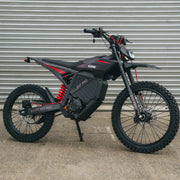
If you are still choosing a bike, our adult electric dirt bike buyer's guide covers the specs worth reading and the claims worth ignoring, and the Sur-Ron alternative guide covers how the K47 Pro compares with the brand most people start from. See the K47 Pro →
Frequently asked questions
Do I need a licence to ride an electric dirt bike? The licence requirements GOV.UK sets out apply to public roads. Off-road, the real question is what a rider can actually handle. Bear in mind the K47 Pro is built for riders 5'6" to 6'7" and is not a children's bike.
Do I need insurance? The legal requirement GOV.UK sets out covers a road or a public place. On genuinely private land it does not apply — but some land that feels private may still be a public place, and "not required" also means "not covered".
Can I insure one anyway? For theft, often yes, through a home contents policy or a specialist one. For riding, cover for off-road use is a specialist product rather than ordinary motor insurance. Ask an insurer who writes off-road policies rather than assuming a standard motorbike policy will do it.
Does my car insurance or motorbike licence help? Don't assume so. Ask your insurer directly whether your policy extends to an unregistered off-road machine — the answers vary.
What about green lanes and byways? These are public rights of way, so treat them as requiring a road-legal vehicle. Check with the local highway authority before riding one.
Is my own garden private land? An enclosed garden the public cannot wander into is the clearest case there is.
Do I need to tell DVLA I own one? Registration requirements attach to road use. If you are unsure about your own machine, DVLA is the place to ask.
Is any of this different for a child's bike? The position is the same in practice, because neither is road legal. We cover the parent's version of this in our where can kids ride guide.
The bottom line
On land that is genuinely private, where you have permission to be, the road and public-place requirements GOV.UK sets out do not apply. That covers the overwhelming majority of the riding people actually do, and it is simpler than the internet makes it sound.
The two things worth taking away are that public place is a wider idea than road, so check what you are riding on; and that having no legal obligation to insure is not the same as having nothing worth insuring.
This article is general guidance on the law in the UK as at 6 November 2026 and is not legal advice. Rules change, and your own circumstances may differ — check with your insurer and with the landowner before you ride. Kubbi supplies electric bikes and scooters to over 15,000 UK families. Everything ships from our own UK warehouse with a 12-month warranty and UK-based support.