
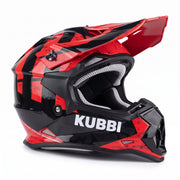

Quick answer: One measurement gets you the right size to order — a tape measure round the widest part of the head, just above the eyebrows. Then when the helmet arrives, four quick checks tell you whether it actually fits before your child rides in it. The whole thing takes about ten minutes across the two stages, and it's the difference between a helmet that protects and one that just sits there.
If you're still deciding which helmet to get, start with What Helmet Does My Child Need for an Electric Dirt Bike? — this guide is about getting the size right.
Before you order: getting the measurement right
It's one number, but it's worth taking properly, because everything else follows from it.
Run a soft tape measure around the widest part of the head — roughly 2cm above the eyebrows at the front, and around the fullest part at the back. Keep it level the whole way round. Note the number in centimetres.
The four ways this goes wrong:
The tape slips up at the back. The most common one by far. The back of the tape wants to ride up over the crown, which gives you a smaller reading than reality. Get someone else to check it's level, or do it in front of a mirror.
Measuring over a thick fringe or a bun. Flatten the hair down first. A ponytail or bun at the back will throw the reading out completely — take it out.
Pulling it tight. Snug against the head, not compressed. If the tape is digging in, you'll order a size too small.
One rushed go at a wriggling child. Take it twice, ideally at different times of day. If you get two different numbers, take the larger one.
And measure again if you're ordering ahead. Children's heads grow more slowly than the rest of them, but if you're buying for Christmas in October, it's worth re-measuring closer to the time. A centimetre matters at these sizes.
The size chart
| Size | Head measurement | Typical ages | Price |
|---|---|---|---|
| Small | 49–50cm | 4 to 6 | £69.99 |
| Medium | 51–52cm | 7 to 10 | £72.99 |
| Large | 53–54cm | 11 to 14 | £74.99 |

The ages are a rough guide. The centimetres are the answer — plenty of seven-year-olds are a small and plenty are a medium.
If the measurement falls between two sizes, go up. The padding compresses slightly over the first few rides, so a helmet that starts out snug tends to settle into a good fit.
Not sure which size? Send us the head measurement before you order and we'll tell you which one to go for. It takes us a minute and it saves you a return. See the helmet range →
When it arrives: four checks before the first ride
Do these indoors, on the day it turns up, before anyone gets excited and heads outside. If something isn't right you want to know now.
1. The roll-off check. Put the helmet on and fasten the strap properly. Then, from behind, try to roll the helmet forward off the head — hand on the back bottom edge, push up and forward. A helmet that fits won't come off. It'll move a bit and then stop. If it rolls forward over the face, it's too big, and that's the check that matters most — a helmet that comes off in a crash has done nothing.
2. The cheek check. With the helmet on, the cheek pads should be in firm contact with the cheeks — enough that it slightly squashes them. That's normal and it's meant to feel like that. Put a hand on each side and move the helmet left and right. The skin on the cheeks should move with the helmet. If the helmet slides around the head instead, it's too big.
3. The brow gap. Slide a finger between your child's forehead and the liner at the front. It should be a firm squeeze, not an easy fit. If there's a comfortable gap, there's too much room in there.
4. The fifteen-minute check. Leave it on for a quarter of an hour, indoors, doing something ordinary. Then take it off and look at their forehead and temples. Even redness that fades in a few minutes is fine. A distinct sore spot in one place, or a mark that's still there after ten minutes, means there's a pressure point — that one's worth talking to us about rather than riding in.
Ask them, too. "Does it hurt anywhere" gets a more useful answer at minute fourteen than at minute one, when everything is exciting.

And the chin strap. Fastened, you should be able to get one or two fingers between the strap and the underside of the chin — no more. If they can open their mouth wide and feel the helmet pull down slightly, that's about right.
Why a helmet to "grow into" is the one to avoid
This is the most common sizing mistake with children's helmets, and it's an understandable one — they grow fast and the helmets aren't cheap.
But a helmet works by staying in place and crushing on impact. A helmet with room in it moves first, and by the time it's finished moving, the head inside it has already hit something. The protection is in the fit as much as the shell.
Going up a size when the measurement is genuinely between two is fine — that's a centimetre of difference and the padding takes it up. Skipping a whole size so it lasts two years isn't, and it's worth spending the extra on a replacement later rather than the whole of this season in a loose one.
How to tell it's been outgrown
Helmets usually go out of service because the child grew, not because the helmet wore out. Signs to watch for:
- The roll-off check starts to fail when it used to pass. Re-run it every few months.
- It goes on too easily. A helmet that's a genuine fit takes a bit of effort over the ears.
- They start complaining it's annoying rather than uncomfortable — often the first sign the cheek pads have given up.
Re-measure once a year, or any time it starts looking loose.
Glasses, hair and other real-world bits
Glasses. A full-face goes on over the top, and the arms should slide into the gap between the cheek pad and the shell rather than being forced. Put the helmet on first, then the glasses.
Long hair. A low, loose plait works better than a bun or a high ponytail, which pushes the helmet forward and ruins the fit.
Cold weather. Don't size up to allow for a hat or a balaclava underneath. Anything thick under a helmet changes the fit, and a thin balaclava is what's designed for it.
If it isn't right when it arrives
Tell us. We'd much rather swap a size than have a child riding in a helmet that doesn't fit.
Get in touch before it's been worn outside, and have the head measurement handy — nine times out of ten we can tell you straight away whether it's a size issue or just a helmet that needs half an hour to bed in. Our returns policy covers the details.
Frequently asked questions
How do I measure if my child won't keep still?
Do it while they're sitting watching something. Or measure a hat or a well-fitting cap with the tape instead and use that — it's not perfect but it's closer than a guess.
They're right on the boundary between two sizes. Which one?
The larger one. The padding settles with use, and a snug new helmet usually becomes a good fit within a few rides. If you'd rather be sure, send us the number first.
The cheek pads feel really tight. Is that wrong?
Probably not. Firm cheek contact is how a helmet is supposed to feel, and it's the bit that surprises most parents. Tight cheeks are normal; a sore spot on the forehead is not.
How long before it needs replacing?
Whenever it's been in a real impact, or when it's outgrown — which with a child is usually first. Check the fit a couple of times a year.
Can I use the same helmet for two children?
Only if they both pass the fit checks on it. Heads differ more than ages do, so measure both.
Do the goggles change the fit?
No — the eye port is designed to take them. Put the helmet on first, then the goggles over the top, with the strap sitting round the back of the shell rather than under it.
The bottom line
Measure round the widest part of the head above the eyebrows, take the larger number if you get two, and order to the chart. When it arrives, do the roll-off check, the cheek check, the brow gap and fifteen minutes indoors.
If anything about it feels loose, it's too big — and a helmet that's too big is the one problem worth sorting out before the first ride rather than after.