

Quick answer: A real motorbike for a child is one with inflatable off-road tyres, real brakes, working suspension, a metal frame and a lithium battery — not a plastic ride-on with hollow wheels. In the UK you can buy one for a child of any age and ride it on private land with the landowner's permission, but never on roads, pavements, parks or bridleways. Size it by your child's height, not their age.
Just here for the bikes? Our range of real kids' electric motorbikes runs from ages 3 to 18, every one with parental speed controls and a UK-held stock of spares. Browse the range →
There's a moment most parents of a bike-mad child go through. You buy the ride-on. It's £120, it's got a picture of a superhero on the side, and for about three weeks it's the best thing that has ever happened. Then your child works out that it does 3mph, the wheels are hollow plastic, it won't go up the slope at the end of the garden, and the whole thing is quietly retired to the back of the shed by August.
So you start searching again — and this time you type the word real.

I know that search, because I hear from the parents who make it. Usually the next thing they say is some version of: I want something proper, but I don't want to be reckless. They've looked at petrol pit bikes and been put off by the noise, the weight, the fuel and the vague sense that it's a lot of machine for a nine-year-old. They've looked at ride-ons and been insulted by them.
This guide is about the ground in between, which is where almost every family actually wants to be. What separates a real motorbike from a toy. What's legal in the UK and what genuinely isn't. And how to match a bike to the child you've actually got, rather than the one on the box.
I'm Paul. I founded Kubbi and we run it out of our own UK warehouse. We sell electric bikes for kids, so I have an obvious interest here — I'm not going to pretend otherwise. What I will do is be straight with you, including about the cases where the answer is to wait.
The two things parents mean by "real"
When parents say they want a real motorbike for their child, they almost always mean one of two things, and it's worth knowing which one you mean before you spend anything.
1. "I want it to be a proper machine, not a toy." You want real components — brakes that stop it, tyres with air in them, suspension that absorbs a landing, a frame made of metal. This is the most common meaning and it's an entirely reasonable thing to want.
2. "I want it to actually go." You want something that will climb the field behind the house, keep up on a trail, and still be interesting to your child in two years' time. Speed matters, but so does torque and range.
Most families want both — and assume that means petrol, or a big jump in risk. It doesn't. Understanding what actually separates a real bike from a toy will save you several hundred pounds.
Where the toy line sits
A plastic ride-on is not a bad product. It's just a very specific product, aimed at a much younger child than most people buying one realise.
Here's what you're typically getting under £200:
- 6V or 12V sealed lead-acid battery. Heavy, slow to charge, and it degrades noticeably within a year.
- Solid plastic wheels, sometimes with a thin rubber strip. No air, so no cushioning and very little grip.
- No suspension. Every bump goes straight into the child.
- A geared plastic drive, not a chain or hub motor.
- Top speed around 3–5mph. Walking pace to a light jog.
- Stabilisers that usually can't come off, because the bike can't balance without them.
- An ABS plastic body over a light frame.

For a two or three-year-old who wants to sit on something that makes a noise and moves, that's genuinely fine. It does the job it's designed for.
The problem is that they're marketed to a much wider age range than they suit. A capable five-year-old will exhaust a 12V ride-on in a fortnight. A seven-year-old will be openly unimpressed. And because they can't handle grass, gravel or any kind of slope, they're a garden-and-driveway product being sold to families who imagined trails.
If your child is under three, buy the ride-on. Genuinely. If they're three or older, or already reasonably confident on a pedal bike, you'll be back searching within the month.
What makes an electric bike genuinely "real"
This is the category that barely existed ten years ago and now covers most of what families actually need. But it's also the category with the widest quality gap, because plenty of manufacturers sell essentially a ride-on toy with dirt bike styling and hope you can't tell the difference.
You can tell the difference. Here's how.
The seven-point check
Screenshot this bit. If a bike doesn't have most of these, it's a toy wearing a costume, whatever the product photography suggests.

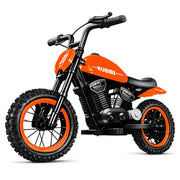
- Inflatable tyres, not solid plastic. This is the single most reliable tell. Pneumatic off-road tyres — 12", 14", 16" — grip on grass and mud, and the air itself acts as a first stage of suspension. Solid or plastic wheels mean the bike is designed for flat, dry, hard ground, no matter what the picture shows.
- Real brakes. A proper bike has real brakes — a lever the child can reach and squeeze, that slows the bike under control. Plenty of ride-on toys have no meaningful braking at all: they simply coast to a stop when the child lets go of the throttle. That's the difference that matters when your child is heading downhill.
- Actual suspension. Front forks with real travel, and ideally a rear shock. Not a spring-loaded cosmetic strut. Suspension is what makes rough ground rideable rather than punishing, and it's the difference between a child riding for an hour and a child riding for ten minutes.
- A metal frame. Steel or aluminium alloy. ABS plastic body panels over a metal frame are fine and normal — a plastic frame is not.
- Chain or hub drive. A chain-driven or hub-motor bike transmits power the way a motorcycle does. Geared plastic transmissions are a toy component and they're the first thing to strip.
- Lithium battery, not sealed lead-acid. Lithium is lighter, charges faster, holds capacity for far more cycles and delivers consistent power as it drains. SLA batteries fade badly and die within a year or two of regular use.
- Multiple speed modes with parental speed controls. This is what makes a real bike safe rather than making a slow bike boring. A proper bike lets you lock a beginner into a low mode and unlock the rest as they earn it.
For reference, that's the standard we build our own range to — inflatable off-road tyres, lithium batteries, metal frames and locked speed modes across every bike we sell.
Real doesn't have to mean fast
The worry that stops most parents right here is that real means fast — that stepping up from a ride-on means handing their child something that gets away from them. It doesn't.
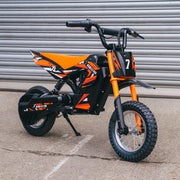
Our smallest bike, the K4, tops out at 15km/h — around 9mph. That's not fast. But it has inflatable off-road tyres, a metal frame, a lithium battery, a twist throttle and two speed modes, so it will climb a grassy bank, handle a rutted track and keep going for about 10km. That's what the step up actually buys you: capability, not pace.
And in its low mode the K4 does 8km/h — near enough the same speed as the plastic ride-on it's replacing. The difference is that it can do 8km/h on wet grass, uphill, without bogging down.
Real is about capability and componentry. Speed is a separate dial, and it's one you control — turn it up slowly.
Is it legal? The honest answer for UK parents
This is the question that stops most purchases, and it deserves a proper answer rather than a reassuring one.
The short version: yes, you can buy your child a real off-road motorbike in the UK. No, they cannot ride it in public.
On private land, with permission
Off-road bikes are legal to ride on private land where you have the landowner's permission. If you own the land, that's you. If you don't, you need the owner's genuine consent.
On private land there is no minimum legal age, no licence requirement, no road tax, no MOT and no compulsory insurance. Readiness is a judgement for you as a parent, not a legal threshold — which is exactly why the sizing section below matters.
Everywhere else is off limits: public roads, parks, pavements, bridleways, cycle paths and council land. That's not a reason to avoid buying — it's a reason to sort out where before you sort out what.
So where can they actually ride?
Realistically: your own garden or land, a friend or relative's land with permission, a farmer's field with a conversation, a pay-and-ride motocross track, or an Auto-Cycle Union affiliated club.
We've written a fuller breakdown of the options in Where Can Kids Ride Electric Dirt Bikes in the UK?
This is general guidance, not legal advice. Rules can vary locally — your council or local force will confirm what applies where you are.
Sizing: height first, age second
Age ranges on product pages are a rough guide and nothing more. Two nine-year-olds can be 20cm apart. What actually matters is height, and specifically whether your child can get their feet down.
The rule that matters: sitting on the bike, your child should be able to put the balls of both feet flat on the ground comfortably. Not tiptoes. Not one foot. If they can't, the bike is too big — and a bike that's too big is the most common cause of a child losing confidence and never getting it back.
Also check:
- Max rider weight. Every bike has one, and going over it wrecks the suspension and the range.
- Bike weight. Can your child pick it up unaided after a fall? If not, can you — repeatedly, in a muddy field?
- Handlebar reach. Elbows should have a slight bend, not be locked straight.

Our range by height
| Model | Rider height | Ages | Seat height | Speed modes | Top speed | Max rider weight | Range | Price |
|---|---|---|---|---|---|---|---|---|
| K4 | 80–115cm | 3–7 | 45cm | 8 / 15 | 15km/h | 40kg | ~10km | £289.99 |
| K7 Pro | 100–145cm | 6–10 | 58cm | 8 / 12 / 25 | 25km/h | 60kg | ~15km | £399.99 |
| K10 Pro | 120–155cm | 7–12 | 67cm | 10 / 20 / 30 | 30km/h | 90kg | ~23km | £599.99 |
| K22 | 128–179cm | 14–18 | 78cm | 25 / 35 / 55 | 55km/h | 100kg | ~50km | £999.99 |
A note on the K22: at 55km/h, and weighing 46kg, it's best suited to a confident rider who already has time on a bike. There's a useful overlap in the sizing — if your teenager is still inside the K10 Pro's height range, its 10km/h bottom mode is a gentler place to begin. If they're taller and the K22 is the right fit, they can still learn on it sensibly by staying locked in the 25km/h mode until they've earned the rest.
There's a fuller breakdown in What Age Can a Child Ride an Electric Dirt Bike?
Real bike, sensible setup
Buying something capable and then setting it up sensibly is the whole trick. A real bike in low mode with a properly fitted helmet is safer than a toy being ridden badly.

Lock the speed. Start every child in the lowest mode regardless of age or confidence, and leave them there for several sessions. Unlock the next mode when they can stop smoothly and predictably on demand — not when they ask.
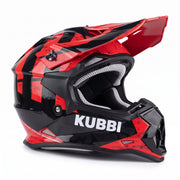
Helmet, always, from the first ride. Correctly fitted, not hand-me-down, replaced after any real impact. Gloves, knee and elbow pads too. Our Youth Dirt Bike Helmet starts at £69.99, and What Safety Gear Does My Child Need? covers fit properly.
Teach braking before speed. Most children instinctively release the throttle and forget the lever. Spend a session on nothing but stopping.
Check the tyres before every ride. Pneumatic tyres lose pressure. An underinflated off-road tyre handles badly and pinch-punctures easily.
So which one is right for you?
Buy the ride-on if your child is under three and you want something for the patio.
Buy a real electric bike if you want something genuinely capable that your child can ride tonight, that won't deafen your neighbours, that charges from a plug socket, and that you can grow with them by unlocking speed rather than replacing the bike.
That second option is what we build, and it's the one that fits most families who typed "real motorbike for kids" into Google — because what they wanted all along wasn't an engine. It was for the thing to be real.
Not sure which size fits your child? Every product page lists a rider height range alongside the seat height — measure your child and let those numbers decide it, not their age. If you're still unsure, get in touch. You'll be talking to our own UK team, not an outsourced inbox — we hold every bike and every spare part here in the UK, and we'd rather tell you to wait a year than sell you something that ends up in the shed.
Frequently asked questions
Can a child legally ride a motorbike in the UK?
On private land with the landowner's permission, yes — there's no minimum age, licence, tax, MOT or insurance requirement. On any public road, park, pavement, bridleway or piece of council land, no.
Do I need insurance for my child's off-road motorbike?
Not legally, for private land use. Some home contents policies cover theft of the bike and some don't, so it's worth checking — these are attractive things to steal.
What's the difference between a kids' motorbike and a ride-on toy?
Inflatable tyres, real brakes, working suspension, a metal frame, chain or hub drive, and a lithium battery. A ride-on toy typically has none of these. It's a difference of components, not of styling.
How fast should a child's first motorbike go?
The top speed matters far less than whether you can limit it. Look for a bike with a low mode around 8–10km/h that you can lock, and unlock as they improve. We cover this in How Fast Do Kids' Electric Dirt Bikes Go?
Is an electric motorbike a real motorbike?
If it has real brakes, real suspension, real tyres and a metal frame, then yes — the power source doesn't decide it. A quiet, capable, chain-driven bike that climbs a hill is more of a real motorbike than a loud plastic one that can't.
At what age can a child start?
From around three on the smallest bikes. Pedal-bike ability isn't a prerequisite — plenty of three-year-olds aren't there yet, and because a throttle takes the pedalling and coordination out of it, some children find our bikes easier to get going on than a pedal bike. That's not true of every child and we wouldn't promise it. What matters more is that they have some balance and that they'll listen and follow an instruction.
Are they hard to maintain?
Far less so than petrol. Charge it, keep the tyres inflated, keep the chain clean and tensioned, and check the brakes. No fuel, no oil, no filters, no carburettor.
Paul founded Kubbi and runs it from the UK. Kubbi supplies electric bikes and scooters to over 15,000 UK families.