
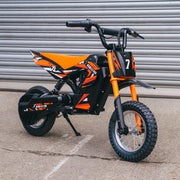



Quick answer: Most screen-free Christmas presents are forgotten by February — not because children are addicted to screens, but because the gift runs out of road. A screen keeps offering the next level. A craft kit doesn't. The screen-free gifts that survive are the ones a child can keep getting better at, which is why a kids electric dirt bike is still being ridden the following Christmas when everything else is in a cupboard.
Just here for the bikes? The whole range, sized by rider height rather than age. Browse the range →
Let's start with the cupboard
You've bought a screen-free present before.
The craft set that did two good afternoons. The science kit that needed an adult sitting with it, so it got done once. The board game that came out on Boxing Day and hasn't since. The building set that was brilliant until the model was finished. The ride-on that was outgrown before Easter.
None of those were bad presents. Parents buy them for exactly the right reasons, and children genuinely enjoy them — for a while. Then the wrapping paper's gone out with the recycling and the thing is at the back of a wardrobe, and by March you're back where you started.
This is such a common experience that it's worth asking why it keeps happening, because the answer isn't the one most gift guides give you.
What you're actually up against
It helps to be clear-eyed about the competition.
Ofcom published its Children's Online Experiences research in May 2026. Children aged 8 to 14 spend an average of 3 hours 36 minutes a day online — just over 25 hours a week. By 15 to 17 that rises to 6 hours 20 minutes a day, which is close to two full days a week.
And 55% of parents of 8 to 17-year-olds say their child's screen time is too high. So if that's how you feel, you're in the majority, and you're not imagining it.
That isn't a moral failing on anyone's part. It's what happens when something is very, very good at holding attention.
And a screen is good at it for a reason worth understanding, because it's the same reason your craft kit lost.
Why screen-free gifts get abandoned
A game console is not competing with your present on fun. It's competing on progression.
Every screen a child uses is built around the same loop: you are slightly better today than you were yesterday, you can see that you're better, and there is an obvious next thing to try. Levels. Ranks. A score that went up. It never runs out, because there's always another rung.
Now hold a typical screen-free present against that.
A jigsaw is completed once. A model is built once. A board game is the same game on the fiftieth play as the first. A craft kit has a fixed number of things in the box. A ride-on toy does exactly what it did on day one, except the child is now bigger.
None of them have a next rung. The child hasn't got bored of being outside or being off a screen — they've finished the thing. And a finished thing can't compete with something that never finishes.
That's the whole mechanism. Once you can see it, choosing a present that lasts gets a lot easier.
The four-question test
Before you buy any screen-free gift this Christmas, put it through these four.
1. Does it get harder as they get better?
Is there a version of this that's still challenging in a year, or is there a ceiling they'll hit in an afternoon?
2. Can they see themselves improving?
Not can you see it — can they? Improvement a child can feel is what brings them back tomorrow.
3. Can they do it without you running it?
If it needs a parent to set up, supervise and pack away, it'll happen at the rate you have energy for. Which in January is not often.
4. Is it better with a friend than alone?
The presents that survive are the ones a child wants to show someone.
Four yeses and it's still in use next summer. Two and you're buying wardrobe filler.
Run your shortlist through it. Most things score one or two.
The one that keeps scoring four

There's a reason we keep hearing from parents that a bike is the gift that stuck, and it isn't loyalty to us. It's that a kids electric dirt bike is one of the few presents built the same way a game is.
Does it get harder? Yes, and deliberately. Every Kubbi has parental speed controls with two or three settings. A child starts in the lowest one, wobbling in a straight line. Weeks later they've earned the next mode. Then the ground gets more interesting — grass instead of gravel, a slope instead of the flat, a bit of mud in February. The bike doesn't change; what they can do on it does. There is always a next rung.
Can they see themselves improving? More clearly than with almost anything else. A child who couldn't turn without stopping in December is carving through a field by March, and they know it. Riding gives you feedback every single second.
Can they do it without you? Once they can ride, yes. You set the speed mode, they get on with it. That's the difference between a present that happens when you have the energy and a present that happens because they asked.
Is it better with a friend? It's the present other children come round for.
Four out of four. That's the whole argument, and it's why the bike is still being ridden the following Christmas when the rest of the presents have gone.
Which one, by age
Match the bike to your child's height rather than their birthday — that's what decides whether they can actually ride it.
| Bike | Rough age | Rider height | Seat height | Speed settings |
|---|---|---|---|---|
| K4 | 3–7 | 80–115cm | 45cm | 8 / 15 km/h |
| K7 Pro | 6–10 | 100–145cm | 58cm | 8 / 12 / 25 km/h |
| K10 Pro | 8–14 | 120–155cm | 67cm | 10 / 20 / 30 km/h |
| K22 | 14–18 | 128–179cm | 78cm | 25 / 35 / 55 km/h |
Measure your child's inside leg — floor to the top of the inner thigh — and compare it to the seat height. You want the balls of both feet down comfortably when they're sat on the seat. There's a fuller walk-through in our Christmas gift guide, and our bike quiz will do it with you.
Frequently asked questions
What is the best screen-free gift for a child?
The one they can keep getting better at. Judge any present by whether it gets harder as they improve, whether they can see themselves improving, whether they can do it without a parent running it, and whether it's better with a friend. Most gifts score one or two out of four.
At what age can a child start riding an electric bike?
From around three, if they're tall enough to get their feet down on the smallest bike. Height matters far more than age — our toddler readiness guide goes through the signs properly.
Isn't an electric bike a lot of present?
It's a big one, and for most families it's the main gift rather than one of several. The way to think about it is cost per year rather than cost: most children ride the same bike for two to three years before sizing up, which is a different sum from a present that's finished by February.
Do I need a big garden?
You need somewhere private to ride, and it doesn't have to be your own. Plenty of families ride at a relative's field, a friend's yard or a local off-road park. What you can't do is ride on a road, a pavement or a public park — our guide to where kids can legally ride covers it properly.
Is it safe for a nervous child?
That's what the speed settings are for. You decide what they can reach, and you move them up when you're ready — not before. Start in the lowest mode, on flat open ground, with a helmet on before the bike comes out — for a dirt bike our Youth Dirt Bike Helmet is the one we’d recommend.
Will they get bored of it?
Not in the way they get bored of a toy, because there's no point at which it's finished. What happens instead is that they outgrow it, usually after two or three years, and move up a size.
The bottom line

Screen-free isn't the hard part. Plenty of presents are screen-free. The hard part is buying something that's still being used when the novelty has gone, and that comes down to whether there's another rung to climb.
Ask the four questions before you buy anything this Christmas. If a present can't get harder, can't show a child they're improving, needs you to run it, and isn't better with a friend — it's going in the cupboard, however lovely it looks on Christmas morning.
Screen time figures from Ofcom, Children's Online Experiences, published 21 May 2026.