

Quick answer: From around four, on a scooter built for that age and kept on its lowest speed setting. But the birthday is the rough guide, not the answer. Two things actually decide it: whether your child can already ride a kick scooter confidently, and whether the handlebars adjust low enough for them. The second one you can check with a tape measure before you order.
The short version, by age
| Age | Where they usually are | What suits them |
|---|---|---|
| Under 4 | Still building balance and steering | A kick scooter or balance bike first |
| 4 to 8 | Confident on a push scooter, ready for a throttle | Kubbi S4 Pro — £189.99 |
| 8 to 13 | Wants more speed and something that handles rough ground | Kubbi S7 Pro — £249.99 |
| 13+ | Approaching the 70kg rider limit | Adult scooters, or an electric dirt bike |
Why the birthday is the least useful number
Two five-year-olds can be a year apart in what they can actually do.
One has been on a push scooter since they were two, belts around the garden, stops without being asked. The other got a scooter at Christmas and still puts both feet down every few metres. Same age, completely different readiness — and nothing about the number five tells you which is which.
That's why the age bands above are a starting point rather than a rule. The three checks below are what actually settle it.
Check one: can they ride a kick scooter?
This is the real prerequisite, and it's worth being straight about.
An electric scooter is ridden standing up on a narrow deck. The balance and the steering are exactly the same skill as a push scooter — the motor only replaces the pushing. It doesn't do anything to help them stay upright.
So the test is simple, and you've probably already seen the answer a hundred times in the park. Can they scoot along at a decent pace, steer around something, and stop, without you holding on? If yes, they're ready for a throttle. If they're still wobbling or putting a foot down constantly, give it a few months on the push scooter first — it'll transfer straight across.
If they've never had a scooter at all, start there. It's the cheapest way to find out.
Check two: do the handlebars go low enough?
The bit most parents forget, and the one that decides whether it's comfortable or a fight.
Handlebars that are too high mean they're reaching up, which wrecks their balance and their steering. Too low and they're hunched over. You want the bars somewhere between their waist and the bottom of their chest, with a slight bend in the elbows.

Our product pages list the exact handlebar height for every scooter we sell, so you can get the size right from your front room in under a minute. All you need is a tape measure:
- Measure your child's waist height. Stand them against a wall in the shoes they'd ride in, and measure from the floor to the top of their hip bone.
- Compare it to the handlebar height on the product page. The S4 Pro adjusts from 74cm to 94cm, and every scooter we sell lists its handlebar height in the specifications.
- Aim for the lower half of the range. That way there's room to raise the bars as they grow, rather than them already being at the top of the adjustment on day one.
If it's borderline, ask us before you order. Sizing is the question we get asked more than any other, and we'd far rather work it out with you in advance than sort out a return afterwards.
Check three: do they stop when you say stop?
The same question we ask about every powered thing we sell, and it matters here too.
Nobody's expecting perfect behaviour — no young child does as they're told all the time. The bar is lower than that. It's whether "stop", "slow down" and "come back this way" get through while they're concentrating on something else. The first few sessions are you standing there giving instructions, and they need to be able to take them in.
If that's not landing yet, it's a few months away rather than never.
Age by age
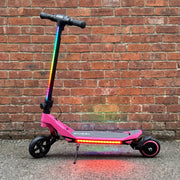
Four to six — the first electric scooter. The S4 Pro on setting one, which is 5 km/h. That's slower than a jog — you can comfortably walk alongside them, which is exactly what you want for the first few outings. Most children stay on that setting for a couple of weeks and then start asking for setting two.
Six to eight — working through the settings. By now they're on 10 km/h and eyeing 15. The S4 Pro's handlebar adjustment does its job here: the same scooter they started on still fits, because you've been raising the bars as they've grown.

Eight to thirteen — the S7 Pro. A 200W motor and 16 km/h, but the real differences are rear spring suspension, which changes how it feels on gravel and uneven paving, and an LED display showing speed and battery. Around 12km of range, and it folds to 44cm.
Thirteen and over. The limit here isn't age, it's the 70kg rider weight on the S7 Pro. Once they're near that, they've outgrown the junior range.
Just here for the scooters? Two sizes, ages 4 to 13, both folding, both with a 12-month warranty. Browse the range →
Their first ten minutes
Worth doing properly, because it sets the tone.
Lowest setting, flat surface, no slope. Nothing with a kerb or a drop at the end of it.
Let them get used to the throttle standing still first. A gentle squeeze, feel it pull, let go. Two or three times, before they go anywhere.
Then straight lines only. No turning until the starting and stopping is comfortable. Turning while accelerating is where the first falls come from.
Helmet on from the very first go, not once they're going fast. It's much harder to introduce later.
Most children have the hang of it inside half an hour. The ones who've ridden a push scooter often have it in five minutes.
Safety kit
RoSPA, the road safety charity, reckons protective clothing could prevent more than 60% of scooter injuries — and their advice for scooters is that a cycle helmet is the right sort of helmet for the job.
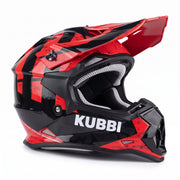
Falls on a scooter go forwards and onto the hands, so wrists, elbows and knees take the impact. Our helmet and safety set is £22.99 and covers all of it — helmet, knee pads, elbow pads and gloves — in sizes for ages 4–9 and 10–15.
Where they can ride
Private land, with the landowner's permission. Not roads, pavements or cycle lanes, because a privately owned e-scooter is a motor vehicle in UK law.
For a scooter that's a lower bar than it sounds — a garden path or a driveway is usually enough. The full picture, including what's changing and what isn't, is in Are Electric Scooters Legal for Kids in the UK?
Frequently asked questions
Is four too young?
Not if they're steady on a kick scooter and the handlebars come down far enough. On 5 km/h the S4 Pro is gentler than most parents expect. If they're not on a push scooter yet, that's the place to start.
My child is five but tall for their age. S4 Pro or wait for the S7 Pro?
Almost always the S4 Pro. The S7 Pro's extra speed and suspension suit a rider with a few years of scooting behind them, not just extra height. Measure the waist height against both ranges and get in touch if it's close.
Can a thirteen-year-old ride the S7 Pro?
Yes, as long as they're under the 70kg rider limit. That's the number that decides it rather than the birthday.
Do they need to be able to ride a bike first?
No. Cycling and scooting are different skills, and it's the kick scooter that transfers. Plenty of children can scoot well before they can cycle.
How fast is the slowest setting, really?
5 km/h on the S4 Pro. Walking pace. You can keep up with them at a stroll.
What if they're between the two sizes?
Ask us. Send us their age, height and how confident they are, and we'll tell you honestly which one fits — including if the answer is to wait a few months.
The bottom line
Four is possible. Six is comfortable. But the number that matters isn't on the birthday card — it's whether they can already ride a kick scooter, and whether the handlebars come down to their waist.
Both take a couple of minutes to check, and getting them right is the difference between a scooter that gets ridden every dry weekend and one that goes back in the box.