
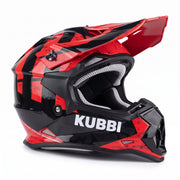

Quick answer: For riding an electric dirt bike, we recommend a full-face helmet with ECE certification — the European standard for motorcycle helmets. It covers the chin and jaw, it's tested to a motorcycle standard rather than a general one, and it's shaped for a child rather than scaled down from an adult. Ours is the Kubbi Youth Dirt Bike Helmet, £69.99, in sizes for ages 4 to 14. Getting the size right takes one measurement round the head.
What a full-face dirt bike helmet gives you
Three things, and they're worth knowing before you choose.
Chin and jaw coverage. Most riding is uneventful and most tumbles are nothing. But when a fall does happen off-road it tends to go forwards rather than sideways, and a full-face helmet has an extended chin guard that covers the jaw and mouth as well as the head. It's the most visible difference between a full-face and an open one, and it's the main reason we recommend them for dirt bikes.
Motorcycle-standard certification. ECE is the European standard for motorcycle helmets, and the testing behind it is built around motorcycle crashes — including the twisting, glancing impacts that happen when someone lands and slides rather than landing square. More on that below.
A shell designed for a child. Not a small adult helmet. The Kubbi Youth helmet is shaped and weighted for a child's head and neck, which matters more than it sounds — a helmet that's too heavy at the front gets taken off.

There's also a sun peak, which does a genuinely useful job on a low autumn sun, and an open eye port designed to take goggles.
What ECE certification actually means
ECE is the European approval standard for motorcycle helmets. It's the thing that separates a real motorcycle helmet from something that just looks like one.
To carry the marking, a helmet has to pass independent testing on:
- Impact absorption, at several points around the shell rather than just the crown
- The chin bar, as a specific requirement in its own right
- The retention system — the strap and buckle have to hold under load
- Durability, so the shell and liner still perform after heat, cold, UV and damp
That's a meaningfully different bar from a general-purpose helmet, and it's why we'd point you at an ECE-marked helmet for dirt bike riding.
SHARP, the UK Department for Transport's helmet safety programme, is clear about what an ECE helmet gives you: "All ECE R22-05 helmets worn in the UK remain compliant and they offer excellent protection."
How to check a helmet is what it says it is
This is the useful bit, and it works on any helmet — one you're looking at, or one already in the cupboard.
Look at the back of the neck roll. An ECE-approved helmet carries its approval marking there. You're looking for ECE R22 and an approval number.
Then check the label inside. There'll be a small sewn-in or printed label carrying the same approval details.
If a listing doesn't mention a standard at all, take that as your answer. Plenty of what gets sold online as a "kids dirt bike helmet" is a costume or a bicycle helmet with motocross styling. A helmet that's been through approval will always say so, because it costs money to get there.
What if they already have a helmet?
Depends what it is, and there's no need to panic either way.
An ECE-marked motorcycle helmet is doing its job. SHARP is clear on this: "All ECE R22-05 helmets worn in the UK remain compliant and they offer excellent protection, so you do not need to rush out and replace your helmet immediately." If that's what you've got, keep using it and replace it when it's outgrown or damaged.
A cycle-style helmet is a perfectly good helmet for what it's designed for, and we sell one ourselves for scooters and general riding. For dirt bike riding, though, a full-face is what we'd recommend — and the more speed your child has access to, the more we'd recommend it.
Any helmet that's been in a real crash should be replaced, whatever standard it is. The protection comes from material that crushes on impact, and once it's done that it's done.
Sizing: one measurement
Helmet fit matters as much as the helmet. A loose one moves on impact and a tight one gets left in the shed.
Take a tape measure round the widest part of your child's head, just above the eyebrows, and keep it level. That single number is your size.
| Size | Head measurement | Typical ages | Price |
|---|---|---|---|
| Small | 49–50cm | 4 to 6 | £69.99 |
| Medium | 51–52cm | 7 to 10 | £72.99 |
| Large | 53–54cm | 11 to 14 | £74.99 |
If they're between sizes, go up. The padding beds in with use, so a helmet that starts out snug tends to settle, and the larger size buys you longer before you're replacing it.
The ages in that table are a guide. The measurement is the answer.
The Kubbi Youth Dirt Bike Helmet
£69.99 to £74.99 depending on size, and it's what we put on our own children.
- ECE certified — tested and approved to the European motorcycle helmet standard
- Full-face with an extended chin guard and a sun peak
- Shaped and sized for children, not a scaled-down adult shell
- Goggle-compatible eye port and an adjustable chin strap
- Five colours — black, blue, red, orange and pink
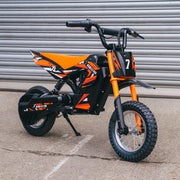
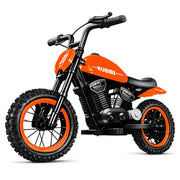
It's designed to go with the K4, K7 Pro and K10 Pro, and it's equally at home on a quad or a pit bike.
Need the helmet and nothing else? Five colours, three sizes, ECE certified. See the range →
Why we recommend goggles too
A full-face helmet leaves the eye port open, which is exactly what you want for airflow and vision — and it does mean the eyes themselves aren't covered.

Goggles are worth the £29.99 for three reasons:
Debris. Grit, stones and mud come off the front wheel, and off anyone riding in front. That's the main one.
Wind. Eyes stream at 25 or 30 km/h, and a child who's blinking isn't looking where they're going.
Branches and hedges. Anyone riding near a hedgerow will tell you.
Our Youth Dirt Bike Goggles are £29.99, with a clear wide-view lens rather than a dark tint, a soft foam face seal, and a strap that fits over the Kubbi helmet range. Yellow, red or blue.
Plenty of riders start without them and add them later. If you're buying both together, it's the easier time to do it.
Is a helmet a legal requirement?
On private land, no. Helmet law applies to public roads, and a dirt bike on private land isn't on a public road.
Which is rather the point: nobody is going to enforce this one for you, so it's your call and your standard. We'd suggest helmet on from the very first session, before it becomes something to argue about.
Frequently asked questions
What does ECE certification mean in practice?
That the helmet has passed independent testing to the European motorcycle helmet standard — impact absorption at multiple points, the chin bar, the strap, and durability. SHARP, the government's helmet safety programme, says ECE helmets "offer excellent protection". It's the marking worth looking for.
We've got a cycle helmet already. Is that enough for the garden?
It's a helmet, and it's better than nothing by a distance. For dirt bike riding we'd recommend a full-face, and we'd recommend it more strongly the faster the bike goes — a K4 on its low setting and a K22 at full chat are different propositions.
What if they're between two sizes?
Size up. And if you're unsure, send us the measurement and we'll tell you which one to order.
How often should a helmet be replaced?
After any real impact, straightaway. Otherwise when it stops fitting — which with a growing child is usually what gets there first.
Is a full-face too hot or heavy for a four-year-old?
It's a fair question and it's why the shell is built for children rather than scaled down from an adult one. There are vents, and the smallest size is genuinely light. Most children stop noticing it within a session or two.
Do they need goggles from day one?
Not necessarily, though we'd recommend them. If your child is riding on grass or dry ground and staying close, you can add them later.
The bottom line
For an electric dirt bike, a full-face ECE-certified helmet is what we'd put our name to — the chin and jaw coverage, the motorcycle-grade testing, and a shell actually built for a child's head.
Check the back of the neck roll for the marking, measure round the head above the eyebrows, and size up if you're between. That's the whole job.