

Quick answer: A plastic ride-on suits a child under three on a flat driveway. From three upwards most families end up buying twice — the ride-on first, then a real bike within the year, because the ride-on can't handle grass, slopes or a child who's getting good. Going straight to a proper bike usually costs less over four years and skips the wasted step.
Just here for the bikes? Our range of real kids' electric motorbikes starts at age three with the K4, every one with parental speed controls and a UK-held stock of spares. Browse the range →
Most parents in this position buy twice
It's the most common conversation we have. A parent gets in touch about the K4, and somewhere in the message is a version of the same sentence: we bought one of those plastic ones last year and he was bored of it in a month.
That's not bad luck. It's the predictable outcome of a product being sold to an age it wasn't designed for.
A 6V or 12V ride-on is engineered for a toddler on a flat, dry surface. It does around 3–5mph, the wheels are hollow plastic, and there's no suspension. For a two-year-old, that's exactly right. For a four-year-old who's worked out it only does walking pace, it's a fortnight of novelty followed by a shed.
The problem is what happens next: you buy again. And the second purchase is the one you should have made first.
What if my child is under three?
Most under-threes will be too small to get a foot down on the K4, and may not yet be ready to control it — a throttle and a brake lever take a bit of judgement, and that develops at its own pace.
Worth saying, though: the age ranges on our product pages are guidelines, not rules. At this end of the scale your child's height, and your own read on how they handle themselves, are far better guides than their birthday. The K4 is built for riders from 80cm, and some children are comfortably there before three while others take a while longer.
If they're close but not quite ready, waiting a few months is usually the better call. Buying something small and temporary in the meantime is exactly the two-purchase trap — you spend twice and end up where you were always heading.
The real cost, over four years
This is the part most comparisons skip, because it's the part that doesn't favour the cheap option.
| Plastic ride-on | Kubbi K4 | |
|---|---|---|
| Upfront | ~£120 | £289.99 |
| Realistic useful life | 1 year | 4 years (ages 3–7) |
| Cost per year | ~£120 | ~£71 |
| Replacement parts | None available | Battery, motor, tyres, charger — all sold separately |
| Battery type | Sealed lead-acid, fades within a year | Lithium, holds capacity for years |
| Warranty | Varies, often none after 6 months | 12 months |
The line that matters most is the one about parts. When a ride-on's battery dies — and it will, because sealed lead-acid degrades whether you use it or not — that's the end of the product. Nothing is available, nothing is serviceable, and it goes to the tip.
Every part on a K4 can be replaced. Battery, motor, controller, throttle, tyres, mudguards — they're all listed individually on our site and held in our UK warehouse. A four-year-old bike with a new battery is a working bike. A four-year-old ride-on is landfill.
What the extra actually buys
Briefly, because we've covered this properly elsewhere: inflatable off-road tyres instead of hollow plastic, a metal frame instead of moulded ABS, real suspension, a proper brake lever, and a lithium battery.
If you want the full version — the seven things that separate a real bike from a toy in dirt bike clothing — it's in Real Motorbikes for Kids: What "Real" Actually Means.
The short version is that these aren't upgrades. They're the difference between a thing that moves and a thing your child can ride.
What changes for your child
The spec sheet is the boring half. Here's what parents actually report back.

Where they can ride. A ride-on manages a patio, a driveway, and a very flat lawn on a dry day. Pneumatic off-road tyres change that completely — wet grass, a rutted farm track, the bank at the end of the field. The riding stops being confined to the concrete.
How long a session lasts. Ten minutes on a ride-on before boredom sets in. An hour or more on a K4, because there's somewhere to go and something to get better at. That's the difference between a toy and an activity.
How much they improve. A ride-on has one speed and nothing to master. A K4 has two — 8km/h to learn on, 15km/h once they've earned it — and that progression is most of the appeal. Children are motivated by getting better at something. A bike that never gets harder never holds them.
How long it stays theirs. The K4 covers ages three to seven and rider heights from 80 to 115cm. That's four years of the same bike, not four years of upgrades.
Where to start instead

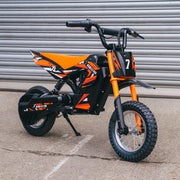
The Kubbi K4 — £289.99, ages 3–7, rider height 80–115cm. Two locked speed modes at 8 and 15km/h, inflatable off-road tyres, lithium battery, around 10km of range. This is the bike that replaces the ride-on step entirely.
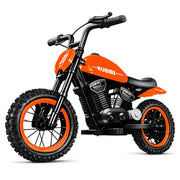
The Kubbi Cruiser — £369.99, ages 3–9. If your child wants a bike rather than a motorbike, this is the same idea in a different shape.
Size it by height, not age. Sitting on the bike, your child should get the balls of both feet flat on the ground — not tiptoes. The full sizing table for the whole range is in the main guide.
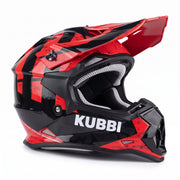
Whichever you pick, a helmet goes on from the first ride — our Youth Dirt Bike Helmet starts at £69.99, and What Safety Gear Does My Child Need? covers how to fit one properly.
Not sure which fits? Send us their height and we'll tell you straight, including if the answer is to wait a few months. You'll get our own UK team, not an outsourced inbox.
Frequently asked questions
Are ride-on toys a waste of money?
Not for the age they're designed for. For a two-year-old on a flat driveway, a ride-on does its job. The waste happens when one is bought for a three or four-year-old who outgrows it within months and needs replacing.
What age should a child move up from a ride-on?
Around three, or whenever they're steady enough to control a throttle and follow an instruction. Pedal-bike ability isn't a prerequisite — a throttle takes the pedalling and coordination out of it, and some children find a proper bike easier to get going on, though that's not true of every child.
Can a three-year-old really handle an electric bike?
On the right one, yes. The K4's low mode is 8km/h — about 5mph, near enough what a plastic ride-on does flat out. The difference is that it'll do 5mph on wet grass and up a slope. You unlock the second mode when they've earned it.
Is a ride-on safer than a real bike?
Not automatically. Slower isn't the same as safer. A real bike with a locked low mode, a working brake and a fitted helmet is safer than a toy being ridden badly with no kit — and it teaches braking properly from day one.
Paul founded Kubbi and runs it from the UK. Kubbi supplies electric bikes and scooters to over 15,000 UK families.